

Although the World River Day passed a few weeks ago, I want to talk about water today. There’s a river called San Diego passing through my neighborhood but you will not see water flowing there. All you see are a few patches of water here and there, which are used by mosquitoes for breeding. There have been some efforts for conservation, and there is good riparian vegetation along the river strip but it is no longer a river. We have effectively killed it. Water no longer flows.
That is why I have never told my daughter that this is the San Diego River. If I do, she will be misled. It will give her the impression that a river is a strip of land with some trees and a few ponds.
We talk a lot about water resource management, but I think we are approaching water in the wrong way. First, we need to stop thinking of ourselves as water managers. Who gave us the right to manage water? Did we create the rivers? If not, why are we managing them as if they exist only for us? More than 100,000 species depend directly on rivers and freshwater ecosystems for survival. We are just one more species that also depends on rivers. We can take some water from rivers or lakes gracefully to fulfill our needs, but we have no right to manage them. We should stop calling ourselves water managers because we certainly don’t know how to manage it. If we did, there would be plenty of water flowing in the rivers of California, including the San Diego River. We tried to manage, but in essence, we destroyed the beautiful river systems that were running wonderfully before our greed took over.
The problem, I see, is that we don’t know the value of water. To understand the value of it, let’s do a simple experiment. Next time you are next to a tap, please hold some water in your palms and meditate upon it. If you do so for a while, the water in your palms will start communicating with the water inside your body. If we can feel the water within us — which makes up more than 70% of our bodies — we will certainly understand how important water is. The water that resides within us will remind us that the water is a valuable life ingredient. If we understand it, we will certainly think about ways to borrow water from natural sources without destroying them. If we don’t understand the gravity of water, we will only continue to destroy our water sources with our mere book knowledge.
To me, water is very precious. When I was a child, I had to fetch water in a vessel from a water source some half mile away while walking on a hilly terrain every day. There was no excuse for wasting water; every drop counted. Water didn’t just flow through a tap automatically — every splash was brought through effort.
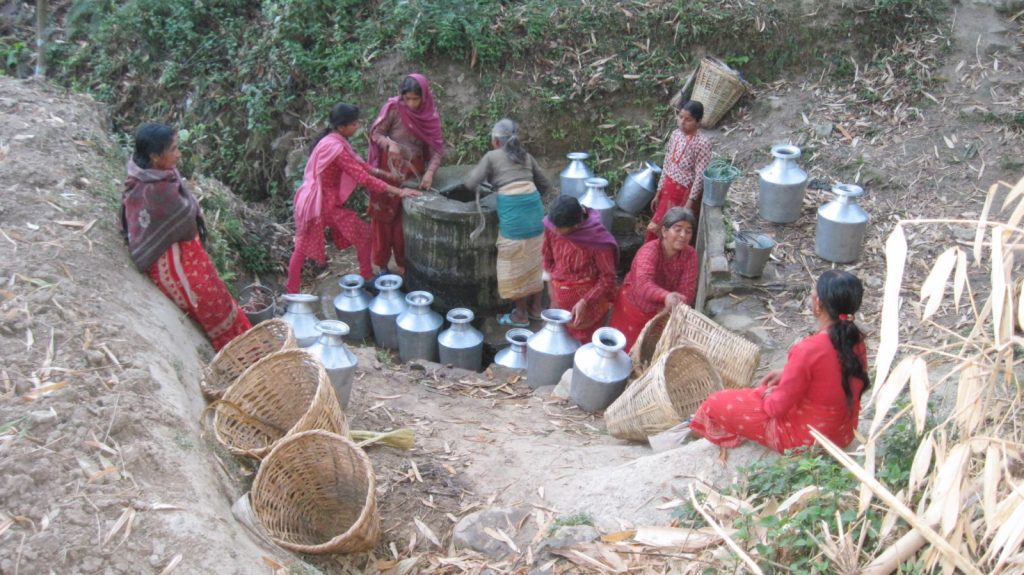
We took a bath with one bucket of water. Another bucket carried us through the whole day. My mother managed to wash a pile of clothes with just one or two buckets of water. She was never taught anything about water conservation.
That is why water is more than a utility bill for me. I feel it. I see it as a part of life. That is why I hold it with care in my palm. I never leave the tap open when brushing or washing my face. I cannot.
Last year, I had the chance to drive through the north–south stretch of California. The Central Valley, once a semi-arid land, was transformed into a rich agricultural region producing fruits, nuts, and vegetables about a hundred years ago. We connected multiple rivers, including the Sacramento and San Joaquin, and built one of the most complex networks of aqueducts, squeezing groundwater to its full extent to irrigate the farmlands of the Central Valley. There is no doubt that what we achieved was an engineering marvel. However, while it might not have been obvious at the time, it is now painfully clear that we have effectively killed the rivers of California.
Now that we have killed the rivers, what are we trying to manage? What are we trying to squeeze out of rivers that are already dead? What are we spending billions of dollars on? What is the cost of restoring a river to its flowing nature? How many billions of dollars?
See, it is not about money. Money can’t bring a dead river back to life — just as it can’t bring a dead person back to life.
So what is the solution? May be begin with repentance? We should probably stop interfering with our natural resources in the name of development. I think all we need to do is – return to our place as much as we can. Let’s leave the rivers alone. That’s all we need to do. Nature will take care of the rest. It may take time, but nature always knows how to heal itself. When we step back, the water will begin to flow again.
Water is not a resource to manage; it is the basic element of life. It is within us. We are 70% water. Let’s acknowledge it and be grateful for it.